

Certificate of Added Qualification in Healthcare Improvement Program

Overview
LEVEL: INTERMEDIATE
The overall goal of the Certificate of Added Qualification in Healthcare Improvement (CAQHI) Program is to provide comprehensive, hands-on training in both the project and leadership aspects of healthcare improvement. Designed for learners with introductory to intermediate knowledge of healthcare improvement, the program prepares participants to lead meaningful change and gain applied experience in improvement science and leading healthcare initiatives.
The program consists of two QI training courses and a leadership-approved healthcare improvement capstone project. Learners work on their selected QI project as part of their coursework, developing it and progressively moving it toward implementation by applying concepts and methodologies in real time across both courses.
Personalized coaching is provided by I-QIPS QI coaches, and CME/MOC credit is available.
For information about the required courses and course schedules, refer to the Program Components section below.
Program Offerings & Schedules
- CAQHI Program - CAQHI-5 | Fall 2025 - Concluded
- CAQHI Program - CAQHI-6 | Fall 2026 - Starts September 2026
Program Components
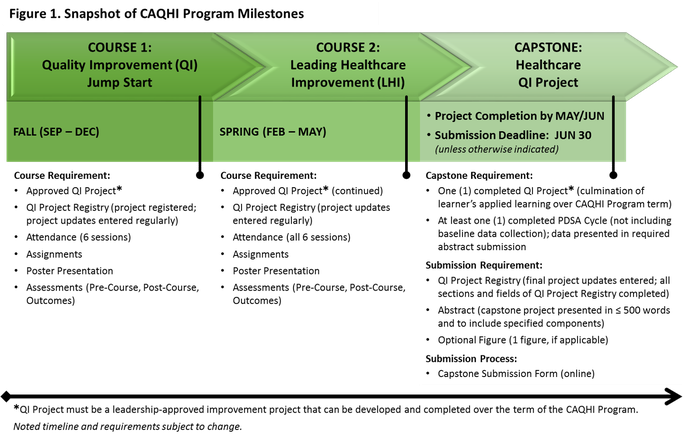
The CAQHI Program is offered annually and begins with Course 1: QI Jump Start in the fall, followed by Course 2: Leading Healthcare Improvement in the spring. Each course consists of six interactive workshop sessions.
Both courses must be completed through the I-QIPS, and each must be successfully completed before progressing to the next step of the program (see Figure 1 below).
The program concludes with the submission of the Capstone Project, which should be completed at the conclusion of Course 1. The final capstone submission is due June 30 (unless otherwise indicated), typically is about one month from the conclusion of Course 2.
Required Courses & Schedules:

COURSE 1
LEVEL: INTERMEDIATE
The educational goal of this intermediate-level QI training course is to provide learners with exposure and hands-on experience in QI and patient safety. The course is designed for learners with an introductory knowledge of the concepts of quality improvement and patient safety, but who would benefit from hands-on experience in applying the learned principles to improve their healthcare practices and to mentor trainees. It is not recommended for those who require a more advanced training program, such as those who are leading QI initiatives or have senior QI administrative roles.

COURSE 2
LEVEL: ADVANCED
The educational goal of this advanced-level QI training course is to develop leaders of interprofessional improvement teams within their clinical settings. The course emphasizes leading healthcare improvements and innovations with an implementation strategy that combines QI or change management techniques. Further, it is designed for learners with intermediate to advanced knowledge of the concepts of quality improvement and patient safety, and who have or will have responsibilities for leading QI initiatives or have other relevant senior QI administrative roles.
Eligibility
The CAQHI Program is open to the following applicants:
- BCM Employees: The applicant must be a current faculty member, fellow/advanced trainee, or staff member at Baylor College of Medicine (BCM) or a BCM-affiliated institution, unless prior arrangements have been made with the I-QIPS Leadership Team before submitting an application.
- Non-BCM Employees: Eligibility also extends to healthcare professionals from non-BCM-affiliated institutions in the Texas Medical Center and the University of Houston who are invited as individuals, as members of an invited department, or as part of an invited institution (space-permitting, subject to change).
Further, the following items are required for all applications:
- QI Project: The applicant must describe a concrete, leadership-approved improvement project on their program application. It should be one that can be developed, implemented, and completed over the duration of the CAQHI Program, spanning the two required courses. Enrolled learners will work on their projects during the courses, advancing them further with each course session by applying the concepts and knowledge gained. The project may be an initiative that the applicant currently is pursuing or one they will begin concurrently with the start of the CAQHI Program (Course 1). To meet the CAQHI Capstone submission requirements and deadline, the project must be in an area where the applicant has substantial control and can reasonably begin at the start of Course 1 and complete by the end of Course 2. Note: Applicants who do not yet have a suitable improvement project are encouraged to apply only after an appropriate project has been identified and approved by leadership.
- Letter of Support Form: The applicant's clinical champion — defined as someone in the clinical area targeted for improvement through the applicant's selected QI project (i.e., where the project will be implemented) — must complete and submit a brief, online Letter of Support (LOS) Form, which serves in place of a traditional letter of support. The LOS Form confirms that the applicant has the full support of their supervisor, leadership, and/or clinical champion to participate in the CAQHI Program, if selected. Specifically, it verifies that the support includes: access to necessary resources for the success of the approved QI Project; approval for full participation in the full CAQHI Program, including both courses; and allocation of sufficient time to attend all course sessions, complete assignments, advance the improvement project throughout the program, and successfully meet Capstone submission deadline and requirements. Applicant Responsibility: When completing the program application, the applicant will be asked to provide the name of the clinical champion submitting their LOS Form. However, it is the applicant's responsibility to provide the LOS Form link to their clinical champion and ensure the form is submitted by the application deadline. Even if submitted on time, an application will not be considered unless the corresponding LOS Form is also received by the I-QIPS by the application deadline. Incomplete applications may not be reviewed.
Goal and Target Audience
The overall educational goal of this advanced-level certificate program is to provide a comprehensive program for hands-on training and experience at both the project and leadership levels of healthcare improvement initiatives.
The CAQHI Program is designed for learners with an introductory to intermediate knowledge of healthcare improvement concepts, who want to lead change within their healthcare system, and who have a particular interest in:
- obtaining hands-on experience in applying to their own projects the learned principles of improvement science, and
- pursuing additional training in leading healthcare improvement initiatives.
The CAQHI Program is open to BCM and invited non-BCM healthcare professionals within the Texas Medical Center and the University of Houston. See the Eligibility section above for more information.
Program participants are selected through a formal application process.
Learning Objectives
By the end of the CAQHI Program, learners should be able to address the following items, as organized by core competency areas:
- Interprofessional Collaboration and Teamwork
- Identify relevant team members to improve a stated healthcare problem
- Demonstrate an understanding of one’s own role and those of other disciplines to advance the health of populations within the context of a healthcare improvement project
- Organization and System Leadership
- Use theories to explain and guide the interactions within and between health system components
- Communicate the value of change to diverse stakeholders and consumers of healthcare improvement information
- Understand how strategic leaders adapt healthcare organizations to meet the demands of organizational environments
- Improvement and Implementation Science
- Identify and justify scientific evidence that is ready for translation into practice
- Use improvement and implementation to promote sustainable healthcare practice change
- Use health care information systems to support healthcare improvement, innovation, and implementation
- Evaluate and analyze implementation strategies
- Methodological Skills and Analytic Techniques for Improvement and Implementation
- Demonstrate ability to conceptually and operationally define measures (process, outcome, and balancing) that are aligned with aims and change ideas (interventions/exposures)
- Demonstrate ability to develop, implement, and evaluate data collection plans
- Utilize appropriate methods to analyze data
Content and Delivery
The educational content and its delivery for this advanced-level certificate program is based on that provided through the required QI training courses conducted by the I-QIPS, as follows:
- Course 1: QI Jump Start - To view educational content and delivery for this intermediate-level course, visit the QI Jump Start Overview page.
- Course 2: Leading Healthcare Improvement (LHI) - To view educational content and delivery for this advanced-level course, visit the LHI Course Overview page.
Criteria for Completion
In order to remain enrolled in the CAQHI Program, learners must successfully complete each of the steps described below; each step serves as a prerequisite and Program requirement for its subsequent step.
STEP 1: Complete Course 1: QI Jump Start* - This intermediate-level course builds upon foundational skills, as well as those concepts acquired from each course session. It includes a series of required (brief) course assessments, administered before the start of the course, immediately after the final session, and again about three months thereafter, for learners to provide updates regarding the progress of their projects, as related to the training received from the course.
STEP 2: Complete Course 2: Leading Healthcare Improvement (LHI)* - This advanced-level leadership training course is designed to develop leaders of interprofessional improvement teams within their clinical settings. Each course session is designed to build upon the content, activities, and assignments from its previous sessions, and a series of required (brief) course assessments is administered before the start of the course, immediately after the final session, and about three months thereafter, for learners to provide updates regarding the progress of their projects, as related to the training received from the course.
STEP 3: Complete and Submit Capstone Project - As the final requirement of the CAQHI Program, each enrolled learner is responsible for completing and submitting one (1) approved healthcare improvement capstone project. The capstone project must be submitted online via the Capstone Submission Form designated for the respective CAQHI Program offering/group (e.g., Fall 2021, Group: CAQHI-1; Fall 2022, Group: CAQHI-2).
The successful completion of the capstone project is based on the continuity of the project (in its development and implementation) across the two required courses, as well as per the stated requirements and criteria described in the respective Capstone Submission Instructions provided for the respective CAQHI Program offering/group, which include the following information:
- Capstone Submission Form
- Project Requirement
- Submission Requirement
- Evaluation Criteria
For the capstone submission deadline and instructions for a given CAQHI Program offering/group, learners should refer to the above Program Offerings list and select the respective offering in which they are enrolled.
The topics covered in the course include, but are not limited to, the following: systems/design thinking and redesign, models for healthcare improvement, basic measures and tools for conducting quality improvement (QI), adult learning theory and mentoring, and QI scholarship.
The successful completion of the QI Jump Start course is based on the stated Criteria for Completion described on the QI Jump Start Course Overview page, where the following course information also is provided: Goal and Target, Audience, Learning Objectives, Content, Delivery, Accreditation and Credit Designation, Evaluation.
The topics covered in the course include, but are not limited to, the following: transformational goals, effective leadership, identifying internal and external stakeholders essential to change projects, cultural barriers and facilitators of organizational change.
The successful completion of the LHI course is based on the stated Criteria for Completion described on the LHI Course Overview page, where the following course information also is provided: Goal and Target, Audience, Learning Objectives, Content, Delivery, Accreditation and Credit Designation, Evaluation.
*Both of the required training courses (see Steps 1 - 2 above) must be taken through the I-QIPS in order to qualify for the Certificate of Added Qualification in Healthcare Improvement.
Program Completion Certificate
At the discretion of the I-QIPS Leadership Team, completion certificates for the CAQHI Program are awarded to eligible learners/course participants to confirm their satisfactory completion of all program requirements. A learner's eligibility to receive a completion certificate is impacted by their successful completion of both program-required courses and their capstone project (including its on-time submission and alignment with all stated requirements and criteria), as described in the Criteria for Completion section above.
Final certificate decisions are made only after all described program requirements have been completed across all enrolled learners.
Accreditation and Credit Designation
AMA PRA Category 1 Credit™ and Maintenance of Certification (MOC) Credit is available for each of the required courses:
- Course 1: QI Jump Start - To view accreditation and credit designation for this intermediate-level course, visit the QI Jump Start - Course Overview page.
- Course 2: Leading Healthcare Improvement (LHI) - To view accreditation and credit designation for this advanced-level course, visit the LHI - Course Overview page.
Program Evaluation
Evaluation of this certificate program is provided through each of the required courses:
- Course 1: QI Jump Start - To view evaluation information for this intermediate-level course, visit the QI Jump Start - Course Overview page.
- Course 2: Leading Healthcare Improvement (LHI) - To view evaluation information for this advanced-level course, visit the LHI - Course Overview page.